
Showing posts with label Useful News. Show all posts
Phone 5G to feature 8MP camera from Sony

“Apple has picked Sony's 8-megapixel camera chip for the 2011 iPhone, according to supply and manufacturing sources, said Rodman Renshaw analyst Ashok Kumar.”
Currently the iPhone’s camera is from OmniVision hint that the 5MP camera will come from them too. Knowing Sony’s phones mounted by their camera modules boast high quality captured images then I must say it’s not a bad choice. Along the way the 2011 maybe time for 4G networks so possibly we can have an iPhone 5G with 4G support.
In the end, it’s too early to tell for 2011 iteration of the iPhone, let’s just see what Apple has stored for us this summer, mainly the iPhone HD and iPhone OS 4.
Privacy leaks hit Facebook, Google, AT&T


AT&T's Web site leaked the e-mail addresses of about 114,000 iPad owners. A browser extension was discovered to leak your Web history to Amazon.com, and if you didn't configure it properly, Google Buzz initially could leak your correspondents' identities.
YouPorn was sued for allegedly taking advantage of a privacy leak that revealed what Web sites had been visited. The leak of Gawker's user database led LinkedIn to disable passwords of users whose e-mail addresses appeared in the file. The discovery that Facebook leaked some user data to advertisers, prompting embarrassing questions from Congress, didn't stop CEO Mark Zuckerberg from being named Time magazine's person of the year.
Google responded to privacy concerns by allowing encrypted Web searches. Congress' response was less successful: Rep. Rick Boucher, a Virginia Democrat, announced widely panned privacy legislation and lost his bid for re-election a few months later. Democrat Bobby Rush's proposal was no more successful. And after over a decade of discussing the topic, U.S. senators couldn't even begin to agree on what kind of new privacy laws are needed. Politicians also failed to advance a proposal backed by Google, Microsoft, and AT&T to update a 1986 law to protect cloud computing privacy.
The Federal Trade Commission decided a "Do Not Track" mechanism for the Web would be nice, but stopped short of saying it should be mandated by law. Not to be left out, the Commerce Department released its own report two weeks later, which took a small step toward endorsing new federal laws regulating companies' data collection practices and requiring that customers be notified of data breaches. Google's congressional critics called for an FTC investigation of its accidental interception of Wi-Fi data, which did not result in a fine.
Concerns over privacy leaks motivated criticism of the federal government, which admitted that full-body scans of Americans entering a federal courthouse were being permanently recorded, prompting worries that would happen with scanners at airports. The Transportation Security Agency denied it, but leaked internal documents showed machines could be configured to do so. Something akin to a national furor, complete with congressional condemnation and an appearance on the Colbert Report, arose after the TSA said travelers at certain airports would be given the choice of scanners or a police-style pat down with what became known as "genital probing."
The biggest leaks of the year, of course, came from WikiLeaks and its impenitent spokesman Julian Assange. WikiLeaks started with the leak of a video shot by an Apache helicopter, continued with the release of hundreds of thousands of U.S. military files related to Afghanistan and Iraq, and achieved international fame and notoriety with last month's slow-motion release of internal State Department cables. While Washington officialdom has been publicly fuming, complete with calls for Assange to be charged with espionage, the cypherpunk-turned-self-described journalist has been holding press conferences in London while fending off an unrelated extradition attempt from Sweden.
Feb. 22 - Dick Cheney heart attack

(Photo by Tom Pennington/Getty Images)
On February 22, former Vice President Dick Cheney was admitted to George Washington University Hospital after suffering chest pains. Test results later determined Cheney had suffered a mild heart attack, his fourth. He was fitted in July with a left-ventricular assist device.
February 19 - Tiger Woods apologizes

February 18 - Plane flown into IRS building

On February 18, Joseph Stack, a 53-year-old software engineer committed suicide by flying a small plane into an IRS building in Austin, Texas. Internal Revenue Service manager Vernon Hunter, who was in the building at the time of the crash, also died. Thirteen others were hurt, two seriously. After the crash police found Stack's rambling suicide note criticizing the government.
February 17 - U.S. missionaries released in Haiti

On February 17, eight of ten U.S. missionaries were released from Port-au-Prince jail after their arrest on kidnapping charges after attempting to transport 33 Haitian children into the Dominican Republic days after the January 12 earthquake. Most of the missionaries came from two Baptist churches in Idaho. The remaining two missionaries were released in March and May.
February 12-28 - Vancouver Olympics

On February 28, the Canadian men's hockey team scored a game-winning overtime goal to beat the United States 3-2, giving the home team its 14th overall gold, the most golds of any nation. The United States lead all countries in medals with 37.
February 7 - New Orleans Saints win the Super Bowl

On February 7 the New Orleans Saints defeated the Indianapolis Colts to win Super Bowl XLIV. The Super Bowl was the team's first in franchise history. Saints' QB Drew Brees was named Super Bowl MVP.
February 5-14 - Snowmageddon

On February 5, the first major snow storm of 2010 pounded the East. New Jersey to Washington, DC received more than 20 inches of snow, closing interstates and shutting down rails. The blizzard was followed four days later by another major snow dump. From February 9-11, Philadelphia to Washington, DC received another 16-20 inches of snow. The winter storms prompted President Obama to refer to the weather system as 'Snowmageddon'.
January 28 - Toyota pedal recall

On January 21, Toyota instituted its second recall after reports of pedals sticking to floor mats, causing people to accelerate without being able to use their break. The recall included 2.3 million vehicles sold in the U.S. and 1.8 million sold in other countries. An addional 1.1 million more Toyota vehicles were recalled a week later. After several Congressional hearings and testimony, Toyota deemed the recall repairs had been effective in solving the issue.
January 27 - Apple unveils the iPad

On January 27th, after months of speculation, Apple Inc. CEO, Steve Jobs, unveiled the company's first tablet computer, the iPad. The mobile tablet provided the functionality of a MacBook laptop and the mobility of an iPhone. The iPad hit shelves in April of 2010 and sold more than 3 million units in just 80 days.
January 22 - Conan's last 'Tonight Show'

(Photo by Michael Buckner/Getty Images)
On January 22, twelve days after NBC confirmed it would be returning Jay Leno to host the 'Tonight Show', Conan O'Brien officially ended his reign as show host, leaving NBC after a bitter dispute. O'Brien announced later in the year that he would be reappearing with his own late night show on TBS called 'Conan'.
January 21 - The Edwards separate

On January 21, Former presidential candidate, John Edwards and wife Elizabeth officially separated one week after the ex-Senator admitted he had fathered a child with mistress Rielle Hunter. In March, Hunter conducted an interview and photo shoot with 'GQ' magazine, explaining details of the affair. In April she appeared on 'Oprah'.
January 19 - Scott Brown elected to Senate

On January 19, Republican Senate candidate Scott Brown shocked the political world, upsetting Democrat Martha Coakley in a special election for Sen. Ted Kennedy's seat. Brown's victory tipped the Senate away from a Democratic Super Majority.
January 12 - Haiti earthquake

(Photo by NICHOLAS KAMM/AFP/Getty Images)
On January 12, a 7.0-magnitude earthquake shook Port-au-Prince, Haiti, toppling buildings and destroying most of the country's infrastructure. The Haitian government estimated 230,000 people were killed, more than 300,000 injured, and more than one million people left homeless. Humanitarian aid began flowing into the country within hours of the quake, however it was not enough to prevent rioting in the economically ravaged nation. January 7-2010

On January 7, the Alabama Crimson Tide rolled over the Texas Longhorns 37-21 to capture the school's first national title since 1992. Game MVP, and Heisman Trophy winning running back, Mark Ingram scored two touchdowns.
Top 10 Searches of year 2010


Top 10 Searches
Since 2001, Yahoo! has been tallying up the top searches of the year, providing a snapshot of a culture in motion. Over the past decade, the No. 1 slot has been occupied by companies (music download service Kazaa), TV shows ("American Idol"), and celebrities (Britney Spears, often). In 2010, some 631 million people checked in. Among the billions of queries they pursued, the story of the Gulf of Mexico oil spill led the year's top 10 -- the first time that a news story has taken the No. 1 slot.
Following the Deepwater Horizon oil rig explosion that killed 11 on April 20, the gushing crude took 86 days to cap. The live feed from the ocean floor became must-watch viewing, as massive online scrutiny monitored best (and not so best) efforts to kill the well and stop the worst spill in marine history. Besides igniting the issue of workplace safety, the disaster became a lightning rod for people's feelings about America's energy policies, big government, billionaire CEOs, environmental protection, and technological safety.
Another event did distract from the drama 5,000 miles deep in the Macondo Prospect. South Africa, the first African nation to host the FIFA World Cup, welcomed 32 nations in a global tournament of men's soccer. People took an online crash course in the sport, learning about the rules of the game, the major players (and outrageous referees), the octopus oracle, and native horns that just wouldn't quit. The summer break brought productivity to a standstill and landed the World Cup in second place on our top 10 searches.
Dizzying tech advances belied a bad economy. The iPhone's fourth coming captivated naysaying geeks and covetous consumers alike, and beat out the iPad in searches. An accidental sneak peek unfolded like a joke ("So this engineer walks into a bar..."), but ended in record lines at stores. High-tech drama stimulated an already frenzied Mac cult (which was also tracking the Apple iPad), and pushed the iPhone into the No. 6 slot.
Filling out the other top 10 spots? Guilty pleasures like "American Idol," the Web-spun music artist Justin Bieber (in his first top 10 appearance), and a bevy of pop culture's young leading ladies -- Megan Fox, Kim Kardashian, Lady Gaga -- who could give lessons in the art of the manufactured self.
What's notable isn't just what commanded people's online vigilance the most, but who almost dropped from the list. For years Britney Spears dominated the top 10, but she tumbled from her No. 1 spot to No. 5 in 2009. This year -- a relatively quiet one for the music superstar -- she hung in at No. 10.
Is the end near for Spears? Don't count her out yet. Dive deep into the top searches and stories of 2010, and get a glimpse at what lies ahead.
iPhone
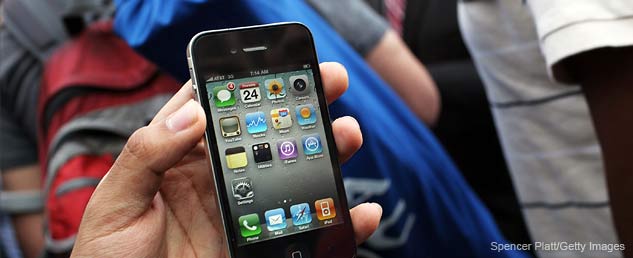
By now, the company knows that any shiny object from its dream factory will get followers queuing up. What could another iPhone iteration -- still tethered to AT&T service -- possibly offer, except to toy with loyalists' affections? Besides, wasn't CEO and cult leader Steve Jobs -- pulled from the brink of a health crisis -- too busy establishing a legacy, like saving the future of news? Yet early word of an upcoming iPhone 4 had fanboys and fangirls agog, as did rumors that Apple would start hooking up with other operators, like Verizon and Sprint.
So an engineer walks out of a bar ...
Then a strange thing happened on the way to the long summer lines. A tippling Apple engineer, celebrating his birthday, inadvertently left behind a prototype at the Gourmet Haus Staudt. And when in a Silicon Valley bar, the natural thing to do with a lost phone is to sell it to blogs for dissection.
The leak became a minor mystery (how could notoriously tight-lipped Apple lose a prototype?), a cautionary tale of limited customer service (attempts to return the phone were allegedly rewarded with a ticket number), an ethical dilemma (Gizmodo paid $5,000 for what might be considered stolen property, and an editor's home was later raided), and a story of betrayal (iPhone finder Brian Hogan's roommate ratted him out) and a near escape (engineer Gray Powell apparently still works at Apple).
The future is now
Crime or not, that sneak peek into the phone's features was enough to trigger a new degree of online scrutiny. Jobs's introduction of the iPhone 4 at the summer Worldwide Developers Conference was almost perfunctory. Its leaps-and-bounds features like video calls, HD recording, and the so-called retina display were at once otherworldly and taken for granted.
Jaded reactions to iPhone 4G spurred Salon to muse about Future Fatigue, a mindset proposed by "Neuromancer" author William Gibson, in which youngsters weaned on tech miracles "inhabit a sort of endless digital Now, a state of atemporality enabled by our increasingly efficient communal prosthetic memory." In other words, smart phone is as smart phone does. Naturally, not everyone was so blase -- presumably not those who bought an estimated million-plus on day one.
IPhone losing its grip?
So, some might have experienced a little malicious glee -- and relief -- to discover that the iPhone 4 was imperfect after all. A design flaw -- namely, lost reception depending on how one held the phone -- led people to search the Web for "death grip iphone."
People followed the back and forth, which included the staid Consumer Reports declining to recommend the fourth generation. In turn, Apple declared regretfully that it had overstated the phone's signal strength all along (which almost sounded like bragging). More condemnation and a class-action lawsuit seemed to threaten Apple's stock price. After a few weeks, the media fuss (summed up in a YouTube video, "The iPhone Antenna Song") was finally settled with free bumper cases for all.
Droid wars: This time, it's personal
The antenna fuss hid a far more seething battle. Google's Android rose up as a legitimate contender in the smart phone market. Consumers researched the merits of "iphone vs. droid," and the latter's popularity possibly accelerated Apple's hustle to get a deal with Verizon.
The New York Times, though, read something much more "personal" going on between CEOs Jobs and Eric Schmidt, a clash that "offers an unusually vivid display of enmity and ambition." If Jobs' potty-mouthed call-out of his competitor's mantra wasn't a seven-letter clue already, then look to Apple's patent infringement lawsuit against HTC, the purchase of Quattro Wireless (a competitor to AdMob, bought by Google in 2009), and Apple's backing of Microsoft's Bing as the default iPad search engine.
Android wasn't the only rival that Jobs threw jabs at in 2010. During an October earnings call, his fighting words pointed out that Apple had passed up RIM, described the Android as "very, very fragmented," and predicted that tablet challengers would be "dead on arrival." With an in-your-face attitude like that, no wonder Jobs emerged as the year's most followed CEO online.
The i's have it
Apple also freshened up a posse of other products in 2010: iPod, iTunes, Apple TV, and MacBook Air. Only the iPad came close to the iPhone in generating rapturous anticipation for its Zen template of possibility.
The one thing people have still been clamoring for (besides the "verizon wireless iphone") is the white iPhone, as elusive as a unicorn. The date, Apple announced apologetically, will come sometime in spring 2011.
Football World Cup 2010

Hail the vuvuzela!
Productivity nearly ground to a halt when those horns starting buzzing, signaling the FIFA 2010 World Cup. As predicted, 2010 emerged as an incredible sports year. For 30 days in summer, men's soccer (aka football) became the world's sport.
South Africa was hosting, and the African continent -- so often tied to colonization, poverty, and apartheid in headlines -- could show how far it had come, as well as what still needed to be done. The country cleaned up well: It built five stadiums for the event and fixed up another five for the 32 guest nations who converged on June 11.
Culture cram
People not so familiar with the World Cup were speed-learning online, absorbing everything from the vuvuzela tradition to the Jabulani (ball) controversy. Then there were those brackets and rules (and who might break them) to track. In the first days, the focus was on past and present players like hotheaded Argentinian coach Diego Maradona, Zidane (whose infamous head butt made his bald pate familiar among online sports fans), Wayne Rooney, and Christiano Ronaldo.
Soccer jerseys became summer wear and a point of national pride. Viewers wondered, "What is that buzzing noise?" And players and commentators bickered over whether Africa's long horn should be banned from the stands. In defense of haters, a single vuvuzela registered 127 decibels, louder than a drum (122 decibels) or a referee's whistle (121.8).
Upsets, heartbreak, and an octopus
By week two, the vuvuzela buzz had became part of the online buzz; and the World Cup, part of daily life for millions around the world. People were glued to live streams and catching up on "basic soccer rules." More players became household names: Fernando Torres, Didier Drogba, Piala Dunia, Fabio Cannavaro, Iker Casillas.
For a game in which points scored can be counted on one hand, a surprising number of upsets kept the crowds entertained. At one point, the FIFA president offered apologies to England and Mexico for referee errors. The drama with Ghana, the only African semifinalist, ended in heartbreak when Uruguay, the only South American finalist, scored a penalty shoot-out to break the 1-1 tie.
The only reliable oracle turned out to be an octopus: Paul, an English expat making his home in Germany's Sea Life center, "predicted" the winners in eight games. (Paul ended his two-year cephalopod lifespan on October 26 at the aquarium, which planned a shrine to mark his cremains.)
Finesse over fouls
By the end, finesse won out over fouls when Spain's Andres Iniesta shot a goal in overtime, winning 1-0 over the Netherlands. The winning team's bounty was $30 million (not including the $1 million that all 32 teams received for preparations), while the Netherlands contented itself with $24 million for second place. Teams that made the group stage or higher got consolation payouts ranging from $8 million to $20 million.
But most of all the 2010 World Cup came down to pageantry. The year was already primed to be one of the greats for international sports. The soccer tournament had its running theme of competitive machismo, but it was also about cultural exposure and shared pet peeves (that buzzing noise).
People exulted over wins, scrutinized the parade of flags, learned the "Waka Waka" song, added a few choice words to their vocabulary, and even learned to love the vuvuzela -- at least, they did if that's what searches on the horn's history and "where to buy the vuvuzela" indicate.
Anticipation has already built up for 2014, which will be held at 12 cities in Brazil, where soccer is the nation's most popular sport and all its players are known by a single name. No vuvuzelas there, but the world will expect a party from Carnival country.
--Vera H-C Chan
BP oil spill

As BP struggled to control nature, technology, and the ire of humankind, forces converged to assist the multinational company in containing the mess. Still, the horror seemed to unfold in slow motion, as the spill approached the ecological disastrousness of the 1989 Exxon Valdez crash and became the most searched term on Yahoo! in 2010 -- a first for a news story since we started compiling Top 10 searches a decade ago.
Spill cam: must-see video
The techie Obama administration, as part of its usual modus operandi, made updates on its site and YouTube channel. Against BP's wishes, U.S. senators insisted on the live camera to show ocean-floor operations. That underwater camera turned out to be the most compelling programming decision of 2010: Viewers obsessively tuned in on their computers and mobile phones to see the best -- and not so best -- efforts to contain the mess.
Searches on all aspects of the crisis, investigation, and damage surfaced daily. People went online to study vocabulary like "junk shot" and "top kill," words that sounded like shade-tree mechanic jargon for improvised solutions. By June, the public anger against BP and its bumbling CEO reached a crescendo and was mercilessly parodied (as in the Upright Citizens Brigade viral video). In July, a cap at last brought some resolution to the leak, but no relief from the devastation that ground industries to a halt, killed wildlife, and shifted political tides.
Rorschach oil blot
At its core, the BP oil spill was about workplace safety and America's energy policies. But the longer the saga unfolded, the more the spill became a kind of Rorschach blot where people could project their present-day anxieties (and a few age-old ones as well):
--- Texas representative Joe Barton's flip-flopping apologies (first to then BP CEO Tony Hayward for the "shakedown" compensation fund, then a mea culpa for that apology) reflected the grumpy tea-party mood about big government and the need for governmental pressure and oversight.
--- Billionaire CEO Hayward's own gaffes (especially his plaintive words to "The Today Show" about wanting to get his "life back") galled a nation already crabby with bosses who earned big bonuses or parachuted out of failing companies with million-dollar compensations. The galling didn't end: He got the boot after 28 years on the job, and received a $1 million severance and a pension plan worth $17 million.
--- There was even a whiff of colonial resentment, as a few English people took offense at the insistence in calling BP by its old name, British Petroleum. (It was probably for the best that few took notice of BP's original names, Anglo-Persian Oil Company and Anglo-Iranian Oil Company.)
--- The specter of Katrina hovered over all this: The hurricane's fifth anniversary was only months away, and many were watching to see how the Obama administration would avoid the missteps of the Bush White House in dealing with disaster.
--- At a time of instant gratification and technological marvels, the wreckage reminded people of the limits to humankind's ambitions.
In crisis, American ingenuity
The story wasn't all hand-wringing and finger-pointing. Gulf residents queued up to find clean-up jobs, partly because the spill had disrupted their livelihood and partly because they wanted to help.
Spectators learned about deep-sea science -- and about how much we didn't know. Yet, typical of the American spirit, people sought out and offered up YouTube theories and volunteered to craft homey remedies (pantyhose stuffed with donated hair proved especially popular).
Then emerged the surreal Hollywood moment when actor Kevin Costner stepped up with a centrifuge oil-cleanup machine. He wasn't the only contender for hero: Robert Bea, a University of California, Berkeley, engineering professor, turned out to be the Chesley Sullenberger of the oil industry as he helped the White House and the public understand what was happening. On the government side, U.S. Geological Survey scientist Paul Hsieh convinced his skeptical team from yanking the last containment cap, thanks to his overnight calculations that proved it would hold.
Out of about 123,000 ideas that poured into BP, more than two dozen were implemented. Within six months, 154 million gallons, an estimated 75 percent of the spill, had been dispersed.
A long aftermath
The cap killed the gushing crude, and the World Cup took the BP oil spill out of the headlines, though by no means out of people's minds. By November, most of the gulf was open for fishing, but worrying signs of deep-sea damage -- such as a die-off of bottom-dwelling coral -- warned of many uncertainties ahead.
The U.S. presidential commission's investigations into the circumstances leading up to the disaster earned criticism, then praise for calling out issues such as BP's "culture of complacency." Its final report is due out in January 2011, but the National Academy of Engineering's interim report, which named names, cast BP as bearing the brunt of responsibility.
For its part, BP has so far repaid the government $520 million in spill costs, although likely more bills will come -- and likely will be paid without too much trouble, since the company returned to profit by its third quarter. A "demonized" Hayward continued to gather more wincing news coverage: The former CEO told students in November, "All of the oil is now gone" (no mention of oil that's buried) and also said, "The biggest lesson I learned was how to manage expectations."
Hayward, who started his own consultancy, may not have to worry anymore about American expectations, but BP still will. No matter the outcome, the oil company's fortunes will be tied to the Gulf of Mexico for a long time to come.


