
Showing posts with label Fighter Planes. Show all posts
Sukhoi Su-35 Super Flanker

Type: Su-35
Country: Soviet Union / Russia
Year: 1994?
Crew: 1
Function: fighter
Engines: 2 * 137.3kN AL-31MF
Wing Span: 15.16 m
Length: 21.96 m
Height: 6.84 m
Wing Area: 62 m2
Empty Weight: 18400 kg
Max.Weight: 34000 kg
Speed: 2440 km/h
Ceiling: 18000 m
Range: 3500 km
Armament: 1*g30mm 8200 kg payload
| Su-35 Specifications | |
|---|---|
| Crew | 1 |
| In-service year | 1996 |
| Powerplant | Two Lyulka AL-31FM afterburning turbofans, 30,855 lb thrust each |
| Armament | One GSh-30-1 30mm cannon with 150 rounds, plus up to 17,636 lb including R-27B/T/TM AAM, R-73R IR/LASER-guided AAM, R-73RM thrust-vector AAM, R-77 AAM, KS-172 AAM-L, Kh-25ML/MP anti-bunker AGM, Kh-29 anti-armor AGM, Kh-29V anti-radar AGM, Kh-31 anti-armor or Kh-31Sh anti-bunker AGM on eleven external points |
| Weights | |
| Empty | 40648 |
| MTOW | 74956 |
| Dimensions | |
| Wingspan | 49 ft 9 in (15.2 m) |
| Length | 72 ft 9 in (22.2 m) |
| Height | 22 ft 5 in (6.9 m) |
| Performance | |
| Ceiling | 59050 ft |
| Speed | 1550 mph (2500 km/h) |
| Range | 2610 mi (4200 km) |
Yak-141 Freestyle

Yakovlev Yak-41/141 Freestyle Design of the Yak-41 began in 1975; the first prototype flew on 9 March 1987, followed by a second in April 1989. Tests were conducted on the aircraft carrier "Admiral Gorshkov". In April 1991, one of the prototypes set several records for VTOL aircraft; it was displayed at the Paris Air Show shortly afterwards. One prototype was lost in a crash (attributed to pilot error) on the carrier in November 1991, after which development was suspended (due to lack of funds rather than any problems with the aircraft); the surviving aircraft was mothballed.
Yakovlev have recently announced their intention to restart development of the Yak-41, apparently as a result of renewed interest from the Russian Ministry of Defence (a similar revival of the twin-turboprop Yak-44 AEW aircraft is also being considered).
A more advanced version, has also been designed, with the emphasis now on Air Force rather than Navy service. This version has an extensively modified airframe, with a strong emphasis on stealth (there is a distinct resemblance to the F-22), a much more powerful engine, and more fuel and payload.
The "Freestyle" has been referred to as both Yak-41 and Yak-141; it appears that one designation refers to the standard fighter (Yak-41) and one to the single prototype modified for record attempts (Yak-141).
Type: Yak-141
Function: fighter
Year: 1989
Crew: 1
Engines: 1 * 15500kg Soyuz R-79V-300, 2 * 4100kg Rybinsk RD-41
Wing Span: 10.10 m
Length: 18.30 m
Height: 5.00 m
Max.Weight: 19500 kg
Speed: 1800 km/h
Ceiling: +15000 m
Range: 2100 km
Armament: 1*g30mm, 2600 kg payload
missiles R-27, R-73 (air to air), Kh-58 (anti-ship) and Kh-25MP and Kh-31P (antiradar)
 |  |  |
YF-23 Black Widow II

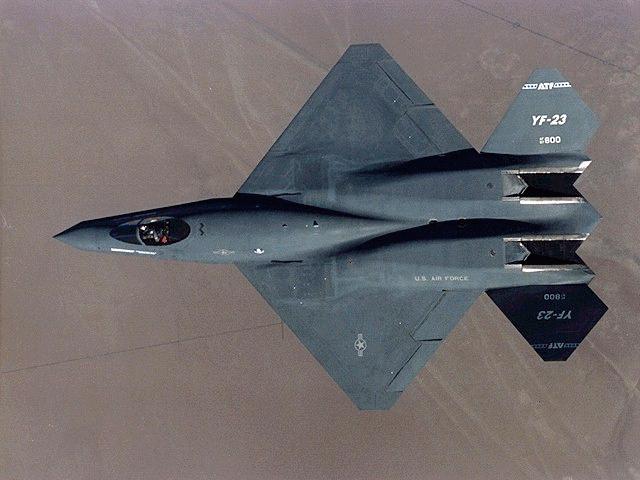
The body of the YF-23A is a blend of stealthy shapes and aerodynamic efficiency, hopefully providing a low radar cross section without compromising performance. The YF-23A was longer and more slender than the Lockheed YF-22A. The main load-bearing fuselage structure, measured from the stablizer to the front of the cockpit, is about 7 feet longer than the YF-22A. From the side, the profile of the YF-23A is reminiscent of that of the Lockheed SR-71. The general impression from other angles is that of a long, high forebody mounted between two widely-separated engine nacelles. The lengthwise variation in cross-sectional area is very smooth, minimizing transonic and supersonic drag. The forward section has a modified double-trapezoid cross section, one above the other in mirror image, with the aft region blending into a circular cross section and disappearing into the rear fuselage. The upper component of the engine box is dominated by two parallel engine nacelles that blend smoothly into the wing, each nacelle being of a modified trapezoidal cross section. The forebody has the cockpit, the nose landing gear, the electronics, and the missile bay. The YF-23 engine nacelles were larger than they would have been on the production F-23, since they had been designed to accommodate the thrust reversers originally planned for the ATF but later deleted.
Trapezoid-shaped air inlets are located underneath each wing, with the leading edge forming the forward lip of a simple fixed-geometry two-shock system. The placement of the intakes underneath the wings has the advantage in removing them from the sides of the fuselage so that a large boundary-layer scoop is not needed. Instead, the thin boundary layer which forms on the wing ahead of the inlet is removed through a porous panel and is vented above the wing. An auxiliary blow-in inlet door is located on each of the upper nacelles just ahead of the engine to provide additional air to the engines for takeoff or for low speeds. The inlet ducts leading to the engines curve in two dimensions, upward and inward, to shield the faces of the compressors from radar emitters coming from the forward direction.
The leading edge of the YF-23A's wing is swept back at 40 degrees, and the trailing edge is swept forward at the same angle. When viewed from above, the wing has the planform of a clipped triangle. On the YF-23A, every line in the planform is parallel to one or the other of the wing leading edges, which has become one of the guiding principles in stealthy design. The wing is structurally deep, and there is ample room for fuel inside the wing box.
The wing has leading-edge slats which extend over about two-thirds of the span. The trailing edge has a set of flaps inboard and a set of drooping ailerons outboard. In contrast to the Lockheed YF-22A, no speedbrake is fitted to the YF-23A.
The all-flying twin V-tails are set far apart on the rear fuselage. They are canted 50 degrees outwards in an attempt to avoid acute corners or right angles in elevation or front view. These all-flying tail sections are hinged at a single pivot. Their leading and trailing edges are parallel to the main wings but in a different plane. The all-flying canted tails double as shields for the engine exhaust in all angles except those immediately above or hehind the aircraft.
In the YF-23A, Northrop elected not to use thrust-vectoring for aerodynamic control. This was done in order to save weight and to help achieve better all-aspect stealth, especially from the rear. All controls are by aerodynamic surfaces. The V-tails work in pitch, roll, and yaw. The wing trailing edge controls provide roll control and lift augmentation, but they also function as speedbrakes and rudders. For straight line deceleration, the control system commands the outer ailerons to deflect up and the inboard flaps to deflect down, thus producing a decelerating force but creating no other moments. Yaw control can be provided by doing this on one side only.
There is a midair refuelling receptacle located on the upper fuselage behind the pilot's cockpit. Like the YF-22A, the YF-23A has a fly-by-wire system that controls the settings of the aerodynamic surfaces in response to inputs from the pilot.
The edge treatment is sustained on the fuselage afterbody, where a jagged-edged boat-tail deck fills in the gap between the two V-tails and blends the engine exhausts into the low-RCS planform. Unlike the YF-22A, the YF-23A does not use thrust vectoring. The exhaust nozzles are located well forward on the upper fuselage, between the tails, and are of the single expansion ramp type. There is one variable external flap on top of each nozzle, and the lower half of each nozzle is faired into a curved, fixed ramp. The engines exhaust into tunnels or trenches cut into the rear fuselage decking. These trenches are lined with head-resistant material, cooling the engine exhaust rapidly and making for a weaker IR source.
In the pursuit of stealth, all of the weapons carried by the F-23 were to have been housed completely internally. The forward section of the fuselage underbelly was flat, with a capacious weapons bay immediately aft of the nose gear bay. The bay could carry four AIM-120 AMRAAM air-to-air missiles. The missiles were to be launched by having the doors open and the missiles extend out into the airstream on trapezes. The missiles would then drop free and the motor would fire. The doors would then immediately shut, minimizing the amount of time that they were open and thus possibly causing more intense radar returns. It was planned that production F-23 would have had a stretched forebody, accommodating an extra missile bay for a pair of AIM-9 Sidewinders or ASRAAM air-to-air missiles in front of the AMRAAM bay. In addition, production F-23s would have carried a 20-mm M61 Vulcan cannon fitted inside the upper starboard fuselage just above the main weapons bay.
The first YF-23A, powered by Pratt & Whitney engines, was shipped to Edwards AFB in California in 1989. It was rolled out at Edwards AFB in a public ceremony on June 22, 1990. The first YF-23A flew at the Air Force Flight Test Center on August 27, 1990, with test pilot Paul Metz at the controls. It stayed in the air for 20 minutes. The only problem during this first flight was a left main gear which failed to latch correctly. A further four flights had taken place by mid-September, including flights at supersonic speeds and inflight-refuelling tests with a KC-135 which were carried out on September 14.
The second YF-23A (87-0801), powered by General Electric YF120 engines, followed on October 26. Both YF-23s remain in storage at Edwards AFB.
| Technical Description | |
|---|---|
| Length | 67' 5" (20.6 meters) |
| Wing span | 43' 7" (13.3 meters) |
| Height | 13' 11" (4.3 meters) |
| Max Take Off Weight | 64,000 lb (29,029 kg) |
| Speed | Mach 2 |
| Range | 864-921 miles (750-800 nautical miles) unrefuelled |
| Armament | Four AIM-9 Sidewinder missiles are carried in internal bays in the sides of the engine intake ducts. Four AIM-120 AMRAAM missiles are carried in internal bays underneath the air intakes. |
| Crew | 1 |
| Unit cost | Unknown |
| Constructor | Northrop/McDonnel Douglas |
Type: YF-23A Black Widow II
Function: fighter
Year: 1990
Crew: 1
Engines: 2 * P&W YF119-PW-100
Wing Span: 13.29 m
Length: 20.54 m
Height: 4.24 m
Wing Area: 88.25 m2
Empty Weight: 14970 kg
Max. Speed: 1915 km/h
Armament: 1*g20 mm
 |  |  |
